
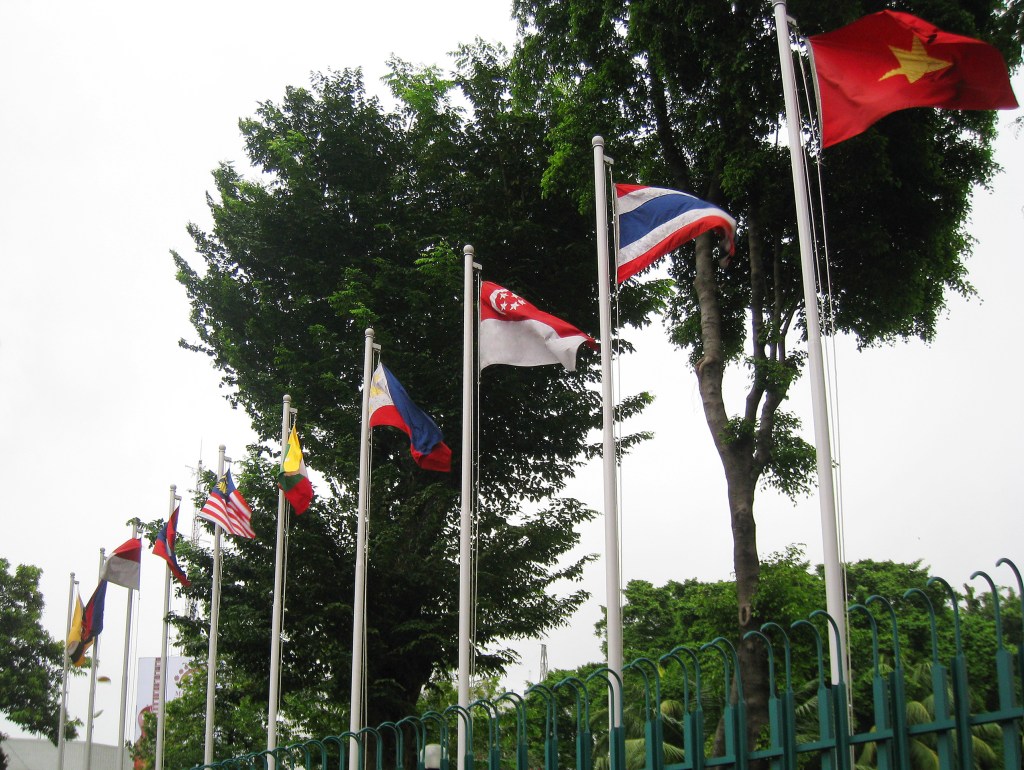
This article was originally included in our Fall 2024 edition.
I. Introduction
China recently, in mid-October, undertook a massive military exercise in the Taiwan Strait that experts pegged as a rehearsal for blockade. Such ongoing posturing by the Xi government has put Taiwan and many of its ASEAN neighbors on edge. Southeast Asian nations have historically engaged in a game of economic versus geostrategic balancing with China. However, they now face an escalating geopolitical challenge as China’s growing assertiveness in its claims over Taiwan and the South China Sea poses increasing risks to their interests.
Because of a capricious foreign policy demonstrated by on-again, off-again push-back against China’s territorial ambitions in the South China Sea and equivocal posturing as an independent middle power, the Philippines, in particular, provides an intriguing case study. This paper explores how the Philippines’ shifting foreign policy, which fluctuates between cooperation and contention toward Chinese island claims and plays off pro-China stances against a return to stronger ties with the United States, affects ASEAN’s broader approach to China, particularly in relation to Taiwan and the South China Sea.
II. ASEAN’s Responses to China’s Aggression
While the Philippines’ response to China’s posturing in the Taiwan Strait and the South China Sea is significant, it is part of a broader Southeast Asian dilemma. As a collective, ASEAN has struggled to present a unified response to China’s growing regional influence. ASEAN countries each possess their own economic and security priorities and have thus seemed disjointed in the face of China’s assertiveness, which points to a lack of cohesion in their response to China.
Singapore, an influential ASEAN member, has positioned itself as a key player in regional security. It maintains a strong security relationship with the United States, hosting U.S. military assets, including aircraft carriers and fighter jets, which could potentially draw Singapore into a conflict over Taiwan. While Singapore has maintained a diplomatic balance, its economic ties to China make it wary of provoking Beijing. This reliance is visible in areas such as trade, where China is Singapore’s top trading partner, and infrastructure, with considerable Chinese engagement in programs such as the Belt and Road Initiative. As a result, Singapore frequently avoids actions that may contravene Beijing, knowing that the economic consequences could jeopardize its wealth and strategic security. Former Singaporean diplomat Kishore Mahbubani described the country’s position: “If there is any one country I am pro, it is Singapore […] we must make sure that we do not get involved, we do not take sides,” signaling its commitment to neutrality and national interest above external allegiances.1 Bill Hayton also cites a conversation with Mahbubani, to sum up the country’s dilemma:
Although firmly rooted in Singapore he [Mahbubani] recognises the imagined communities that still exist within its hybrid society. If there’s ever an outright war between America and China there’s no way that Singapore can join a war against China – the population won’t support it. But at the same time, in terms of diplomatic posturing, Singapore’s certainly very careful and very nuanced.2
The potential for being caught between Taiwan, China, and the U.S. is real, and Singapore’s leadership is keenly aware of the risks of alienating either China or the United States.
Vietnam shares a long border with China, making it wary of upsetting its northern behemoth, but still entertains contentious relations with Beijing over the South China Sea. However, like the Philippines, Vietnam’s response to Taiwan’s security is shaped by its own territorial disputes and regional stability concerns. Vietnam is unlikely to openly challenge China on Taiwan due to its proximity and historical ties with the People’s Republic of China. Vietnam’s foreign policy tends to prioritize first, its own national security, then the development of economic cooperation with China, and thirdly, the maintenance of regional stability: a “critical tenet of Vietnam’s strategy is to remain autonomous in foreign policymaking, by any means [, and the] Political Report of the Communist Party of Vietnam’s 13th National Congress in 2021 reaffirmed Hanoi’s pursuit of an independent, self-reliant, and multilateral foreign policy.”3 At the same time, U.S.-Vietnam relations have significantly warmed in recent years. This growing partnership reflects shared economic and security interests, especially in counterbalancing China’s influence in the Indo-Pacific. While Vietnam remains cautious not to provoke Beijing, this rapprochement with the U.S. underscores Hanoi’s efforts to diversify its strategic partnerships. Therefore, Vietnam’s reluctance to openly take sides in the U.S.-China rivalry over Taiwan highlights the difficulty ASEAN faces in formulating a unified approach.
Other ASEAN nations, such as Malaysia, Thailand, and Indonesia, have expressed concerns over regional stability but have generally avoided taking strong stances on Taiwan. Their economic ties with China and desire to maintain peaceful relations in the region often lead them to avoid confrontation. Furthermore, “An absence of clear focal points around which to coalesce presents further difficulties for ASEAN members when trying to overcome the coordination challenges associated with handling relations with the PRC, especially amid intense U.S.-PRC competition in Southeast Asia.”4 ASEAN, as an institution, has thus shown itself to be weak in countering China’s territorial claims, and member states are unlikely to take a firm stance on Taiwan unless their national interests are directly threatened.
The Philippines’ response to China’s posturing in the Taiwan Strait and the South China Sea is part of this broader Southeast Asian conundrum with the PRC. The Philippines is representative of ASEAN’s struggle to present a unified response to China’s growing regional economic influence and expansionist claims. As an ASEAN coastal member-state, it has been both the betrayer and the betrayed. In 2003, the Arroyo administration became the first member state to betray ASEAN solidarity against Chinese entreaties to set aside South China Sea territorial claims and participate in bilateral natural resource extraction. This subject will be dealt with further in the next section. Then, in 2012, the Philippines precipitated another ASEAN crisis when its foreign minister tried to incorporate within the alliance a mechanism for resolving law of the sea claims.
Since 1992, with the first Declaration on the Conduct of Parties in the South China Sea (DOC), ASEAN members with South China Sea disputes, most predominantly Vietnam and the Philippines versus China, had been striving to draft an enforceable mechanism by which ASEAN’s ten members could band together and hold China accountable. On the cusp of the ASEAN’s Cambodian-chaired meeting, Filipino Foreign Secretary, Albert del Rosario, had worked out an ambitious mechanism to give the DOC some teeth on its tenth anniversary:
[…] del Rosario was hoping to agree a draft Code of Conduct that would contain a mechanism to resolve all the maritime disputes between the Philippines, Vietnam, Malaysia and Brunei (and ultimately China too) in just nine months. It appeared wildly ambitious – the timetable one might expect in a business deal, not an international negotiation. The mechanism – a ‘Zone of Peace, Freedom, Friendship and Cooperation’ in which all sides would agree which areas are disputed and then focus their efforts accordingly.2
Foreign Secretary del Rosario sought to first get all ten ASEAN members to agree to his proposal before engaging China. His actions caught China off-guard and its government took umbrage at not being part of del Rosario’s initial discussions; however, “Beijing was working on a counter-strategy: focusing on the country [Cambodia, the ASEAN 2012 Chair] where it had its most leverage.”2
Through initiatives like the Belt and Road, China has invested heavily in Cambodia’s infrastructure, including railways, roads, and ports, while also providing critical financial support that has bolstered the Hun Sen regime. This reliance has made Cambodia a steadfast supporter of Beijing’s interests within ASEAN, often at the expense of regional unity. Thus, China ultimately prevailed when Cambodia threw up all manner of obstacles to eviscerate the Philippine proposal and nearly took down ASEAN by forcing an impasse that prevented the issuing of the association’s traditional and all-important joint communiqué for the first time at the close of the annual conference. Thus, the Philippines had proven an untrustworthy member in 2003 when it broke with member states to work with China in a bilateral, and later trilateral, agreement to develop Spratly Island seabed reserves, and then found itself betrayed when China, by way of Cambodia, thwarted its efforts to form a united ASEAN front to counter Chinese aggression in the South China Sea.
On a broader geopolitical level, the Philippines occupies a strategic position in Southeast Asia as the closest ASEAN country to Taiwan and the southern anchor of the vaunted first island chain. The country also has a contentious relationship with China over its Spratly Island territorial claims. Recent military drills with allies such as the United States, Japan, and Australia reflect Manila’s growing concern about potential regional conflict and its desire to strengthen defense partnerships. In its response to regional disputes the Philippines’ “president (or pangulo in the Filipino language) has oversized influence over foreign policy.”5 This has led to its perceived capricious nature over the years as seen in the Arroyo, Aquino III, and Duterte administrations and now demonstrated by another foreign policy under President Ferdinand Marcos Jr., who has reemphasized ties with the United States while maintaining pragmatic economic relations with China. According to Quilop, this balancing act reflects a pattern of Philippine foreign policy that oscillates between aligning with the U.S. for security and leveraging economic opportunities with China: “[T]he United States is an ally that protects the Philippines’ territorial integrity and sovereignty, while China is a partner that advances economic development.”5
The Philippines’ active participation in joint military exercises underscores its commitment to countering potential threats in the region, but this also raises the risk of entanglement in conflicts involving Taiwan or the South China Sea: “[M]ost Southeast Asians would not support cutting economic ties with China if it invaded Taiwan [and] there would be little incentive for Brunei, Indonesia, Malaysia, or Vietnam to take escalatory action against China unilaterally in the South China Sea […] The Philippines is likely the one major exception.”6 The Philippines is the only ASEAN country to have a signed Mutual Defense Treaty with the United States. This relationship leads many to settle on the Philippines as the most likely ASEAN member state to take a side in support of Taiwan in the face of Chinese aggression in the Strait.
Although as an Asian middle-power country, the Philippines strives to navigate between the two great powers in the South China Sea, namely, China as a territorial expansionist and the United States as a guarantor of safe navigational passage. It views the United States as the guarantor of its geopolitical security and China as its guarantor of economic growth. Quilop sums up this Philippines middle-power dilemma: “The United States, a treaty ally, is generally perceived as the security guarantor of the Philippines’ territorial integrity, while China has become a significant trading partner since the 1990s and is the main partner for economic development.”5 Under the Marcos Jr. administration, Filipino elites have leaned into its pact with the U.S. since “the United States is [commonly understood to be] helping the Philippines develop its defence capabilities and [that it] would assist the Philippines in a conflict;” and, “[t]his has driven Filipino political elites to pursue closer ties with the United States [since ties with the U.S. are seen as] a source of legitimacy […] because US security guarantees are seen as preserving the country’s national integrity and sovereignty.”5 Thus, the Philippines, as a mutual defense treaty participant with the U.S., stands the most likely chance of being drawn into a conflict with China on the side of the U.S. and Taiwan if hostilities break out in the Strait. Quilop posits that “[b]ecause of this, some politicians in Manila oppose closer Philippine-U.S. ties” since in this view, as a treaty ally of the U.S., “Manila would automatically have to come to the assistance of Washington should an armed conflict with China occur, such as over Taiwan.”5However, this is not a sure thing by a long shot, since assisting the United States in such a conflict would require an act of war resolution that only the Philippine Congress, and not the President, can mandate per its Constitution. Nevertheless, this situation places the Philippines as Taiwan’s most likely ally among ASEAN member states in the event of a conflict with China.
III. The Philippines and the Taiwan Strait
The dilemma posed by growing tensions in the Taiwan Strait represents a crossroads between maintaining economic ties with China and safeguarding sovereignty in the face of Beijing’s expansionist policies. The Philippines, with Luzon’s proximity to Taiwan and the country’s geopolitical importance as the southern anchor to the first island chain, faces pressure to carefully navigate these waters in the face of broad claims by a regional hegemon.
Historically, the Philippines has adopted a nationalist point of view concerning disputed territorial claims, notably in the South China Sea, where China’s aggressive actions have threatened its sovereign rights. Contentious claims over the Spratly Islands have been a source of friction between several Southeast Asian countries and China, most notably Vietnam and the Philippines. Vietnam, which shares a land border with China, has been comparatively cautious in its island disputes; alternatively, the Philippines has generally tended to push the envelope against Chinese aggression, which led to a recent landmark 2016 ruling by the Permanent Court of Arbitration in The Hague in its favor.7 Despite this legal victory, the Philippines’ foreign policy has been marked by capriciousness, as seen in the aforementioned decision to temporarily set aside its claims to the Spratlys in exchange for joint energy exploration deals with China in the early 2000s. Under former President Duterte’s administration, this shift toward China then accelerated, as Duterte continued to de-emphasize the country’s island chain claims in spite of the favorable United Nations Convention on the Law of the Sea (UNCLOS) ruling in 2016 at the start of his administration. This approach, while pragmatic in the short term, has been criticized for undermining the country’s territorial integrity.
The Philippine Constitution stipulates that its governments pursue “independent foreign policy.”5 Although the term did not take on widespread valance until used to critique the Duterte administration, the Arroyo government (2001–2010) precipitated an early ASEAN crisis in 2003 by invoking the aura of independence to promote cooperation with the China National Offshore Oil Corporation (CNOOC) in developing deepwater oil reserves. In deciding on pursuing this President Arroyo sided with a small cabal of political elites, including her husband, in a course of action that turned the Philippines into the first ASEAN member country to break ranks by agreeing with Chinato set-aside territorial claims in the pursuit of independence by way of joint-development of the Spratly Island oil reserves with China. In 1990, Li Peng first made the offer to all South China Sea countries to put territorial claims on hold and join China in developing the region’s underwater energy resources.
For thirteen years the Southeast Asian countries had rebuffed China’s offers until this political clique side-stepped Philippine defense and foreign policy agencies to strike a self-interested deal in the name of foreign policy independence.2 Philippine Speaker of the House Jose de Venicia Jr recruited energy veteran adventurer and expert, Eduardo Manalac, to persuade President Gloria Macapalaga Arroyo to utilize the out-sized executive powers of the Philippine presidency to sign an agreement with the CNOOC without input from Defense or State. Vietnam reacted with expected fury, excoriating the Philippines for several months until finally joining in on the deal out of fear of being sidelined. This represented the first fissure in the solidarity of ASEAN countries to block China’s expansionist claims, which “from China’s perspective the success [had been] partial,” in that, “[f]or the first time two ASEAN governments had ‘put aside the question of sovereignty’ and demonstrated a model of joint development;” however, “other governments continued to ignore Li Peng’s offer and lease out blocks to international companies inside the ‘U-shaped line’ on their own terms.”2 Always seeking to avoid multilateral ASEAN agreements in favor of bilateral ones that leverage China’s growing economic clout, the People’s Republic had achieved one of its first successes, winning over one of its most strident opponents as a result of the capricious nature of Philippine “independent foreign policy.” 2
The Philippines continued to shift in fits and starts further toward China during the Aquino III (2010–2016) years, a trend that accelerated under the anti-American Duterte government (2016–2022). Duterte’s administration took steps to weaken the Philippines’ traditional alliance with the United States, favoring closer ties with Beijing and going so far as to threaten to break the U.S. Visiting Forces Agreement (VFA) that gives U.S. “troops access to Philippine military bases.” 2 The election of President Ferdinand Marcos Jr. in 2022 marked a shift in Philippine foreign policy away from China-based economic promises and back toward U.S.-based geographic security guarantees. Marcos had sought a reinvigoration of the alliance with the United States, beginning with the April 2023 agreement to enhance defense cooperation that granted U.S. troops access to four additional military bases “to which U.S. forces will have access under the EDCA [Enhanced Defense Cooperation Agreement], all of which face Taiwan” on top of the five originally listed in the EDCA.8 The 2023 date, however, belies the perceived appearance of icy U.S. relations under Duterte, since its culmination immediately following Duterte’s 2022 transfer of power would mean that negotiations would have had to have started under his government.
Marcos Jr.’s shift, nonetheless, reflects broader concerns about China’s territorial ambitions and its growing influence in the region. Under Marcos Jr., the Philippines has been strengthening geo-security ties with the U.S. Moreover, part of the aforementioned base-access agreements included joint development of mid-sized nuclear energy facilities that could very likely reduce the urgency to develop West Philippine (South China) Sea claims. His government has also exhibited an increasing willingness to align with the U.S. in the face of China’s aggression, particularly regarding Taiwan and the South China Sea.
The resumption of defense agreements and the collaboration on energy projects, including plans for civilian nuclear reactors, reduces the pressure on the Philippines to pursue joint resource development with China in the Spratlys. However, this newfound alignment with the U.S. brings its own challenges, as the Philippines must navigate the delicate balance of maintaining its sovereignty and national interests as a middle-power country while avoiding becoming ensnared in a great power rivalry.
IV. Conclusion
The growing tensions in the Taiwan Strait present a complex challenge for Southeast Asia. As China increases its military presence and economic leverage in the region, ASEAN nations must consider how best to protect their sovereignty while managing their relationships with both China and the United States.
The Philippines is poised to play a central role in how Southeast Asia responds to China’s actions in the Taiwan Strait. Given its strategic location and mutual defense treaty, the Philippines is likely to be a critical ally for the United States in any regional conflict involving Taiwan. The country’s decision to deepen ties with the U.S. under Marcos Jr. and the resumption of military cooperation signals a clear shift in its foreign policy direction.
However, the Philippines’ past flip-flopping on territorial claims, as seen in its dealings with China over the Spratlys, complicates its position. While the U.S.-Philippine partnership has been strengthened, the Philippines must balance this with its economic interests in maintaining favorable relations with China. As a result, the Philippines remains a critical but unpredictable actor in the region.
In the long term, ASEAN will likely continue its balancing act between China and the United States. The region’s lack of cohesion on the Taiwan issue is unlikely to change unless China’s actions lead to direct threats to ASEAN’s collective security. As such, the future of Southeast Asia’s security landscape may depend on how individual nations, particularly the Philippines, navigate the evolving geopolitical dynamics and the role they choose to play in a Taiwan Strait crisis event.
Works Cited
1. Wee, Chua Eng. “Singapore’s Veteran Diplomat Kishore Mahbubani, a China Optimist.” Think China, 21 Aug. 2024, http://www.thinkchina.sg/politics/singapores-veteran-diplomat-kishore-mahbubani-china-optimist.
2. Hayton, Bill. The South China Sea: The Struggle for Power in Asia. Yale University Press, 2015.
3. Tung, Nguyen Cong. “US-China Rivalry Will Be Stern Test of Vietnam’s Diplomatic Juggling Act.” The Straits Times, 29 Aug. 2023, http://www.straitstimes.com/opinion/us-china-rivalry-will-be-stern-test-of-vietnam-s-diplomatic-juggling-act.
4. Ian, Chong Ja. “Herding Cats: Coordination Challenges in ASEAN’s Approach to China.” China Review, vol. 23, no. 1, 2023, p. 307–39. JSTOR, http://www.jstor.org/stable/48717997.
5. Quilop, Raymund Jose. “Consistency amid Seeming Shifts: Philippine Foreign Policy between the United States and China.” Contemporary Southeast Asia: A Journal of International and Strategic Affairs, vol. 46 no. 1, 2024, p. 147-169. Project MUSE, muse.jhu.edu/article/925579.
6. Bing, Ngeow Chow. “How Southeast Asia Might React in a Potential Military Conflict over Taiwan.” Carnegie Endowment for International Peace, carnegieendowment.org/research/2024/06/how-southeast-asia-might-react-in-a-potential-military-conflict-over-taiwan.
7. The South China Sea Arbitration (the Republic of Philippines V. the People’s Republic of China).” Permanent Court of Arbitration, pca-cpa.org/ar/cases/7/.
8.Misalucha-Willoughby, Charmaine. “The Philippine Presidency and Middle-Power Agency.” Asia Policy, vol. 19 no. 2, 2024, p. 57-64. Project MUSE, dx.doi.org/10.1353/asp.2024.a927088.
Photo Credit: Gunawan Kartapranata
 Foreign Affairs Review