
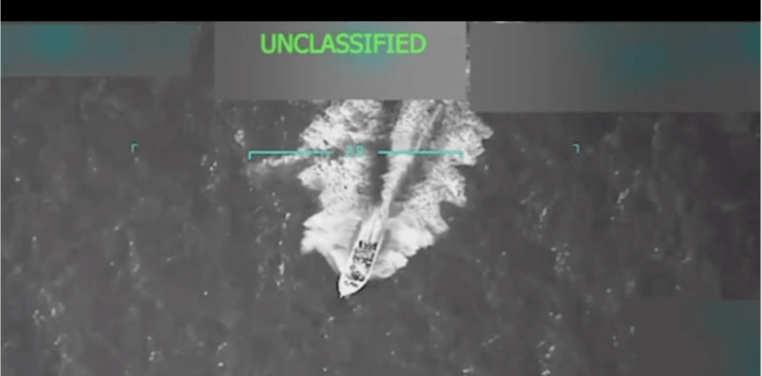
Screenshot from President Donald Trump’s Truth Social post dated Sept. 2, 2025, showing a US military strike on a boat in the Caribbean.
Editor’s Note: This article was originally submitted on November 27, 2025. Some information, statistics, or political developments referenced may have changed since that date.
Since September 2 of 2025, the Trump Administration has launched a series of drone strikes against manned vessels in the Caribbean Sea and the Pacific.1 The strikes have all concentrated off the coast of Central America, where the Trump administration claims to be targeting high rates of drug trafficking and smuggling.2 As the number of individuals murdered by the Trump administration’s drone strikes continues to increase–sitting at eighty at the time of this article’s writing–both domestic and international sources have increasingly condemned their illegality.
The Trump administration has long claimed that the targeted ships, primarily originating in Colombia and Venezuela, are full of individuals attempting to smuggle narcotics through the Caribbean Sea.3 However, for the family members of those individuals suspected to be murdered by the US presidential administration and military, this narrative does not rationalize their deaths. Alejandro Carranza was one of the men suspected to be on a vessel; he is remembered by his niece, Lizbeth Perez, who recalls her uncle’s time working on fishing boats as an integral part of his contribution to their family.4 Her uncle’s disappearance is just one tale of the nearly one hundred people who have died due to American drone strikes.
And yet, more than six months before the strikes began in September, then-acting Deputy Attorney General Emil Bove addressed a conference for the Organized Crime Drug Enforcement Task Forces (OCDETF) at the Justice Department’s National Advocacy Center on the University of South Carolina campus.5 During his speech, multiple attendees recall an official proclamation that the U.S. should “just sink the boats,” rather than interdicting suspected drug vessels.6 Those officials remember the sentiment as such a ridiculous one that they could have never imagined how it would manifest today: with drone strikes against uninvestigated and arbitrarily chosen vessels off the coasts of Central America. The Perez Family’s story is not adaptive American military policy–it is a long-planned and deliberated one, one that the world must continue to condemn.
The calls to end extrajudicial killings in the Caribbean and Pacific started domestically. On October 7, 2025, five members of the House of Representatives wrote an open letter to President Trump stating that the attacks were outside the purview of the US executive branch’s powers as outlined in Article II of the U.S. Constitution. Within the letter, the members stated that the Department of Justice’s claim of cartels being “non-state armed groups” and thus having designations as “terrorist organizations” is inconsistent with the information provided to the House of Representatives and Congress more broadly.7
The open letter was only the first from members of Congress. On October 29, 2025, ten U.S. senators wrote their own letter to Attorney General Pam Bondi. Their letter, while reaffirming many of the representatives’ arguments, goes as far as to state that the killings are “prohibited under domestic and international law in both peacetime and wartime.”8 The specification that these killings are also prohibited in wartime is a key distinction that undermines the Trump administration’s arguments that the strikes have military necessity. The letter cites three violations of American law: 18 U.S.C. § 1111, a felony law prohibiting murder within the jurisdiction of the US including the high seas; § 2.11 of Executive Order 12333, which prevents any person employed by or acting on behalf of the American government from committing an assasination; and Article 118 of the UCMJ, codified in 10 U.S.C. § 918, which prohibits the unlawful killing of a person.9 The Senators go on to detail the international law violations embodied by the extrajudicial killings, including a violation of the Geneva Conventions.10 Such a violation of international law means the strikes are not only an act of domestic illegality, but also a complete disregard of longstanding human rights norms and recognition.
And yet, the condemnations have not only come domestically. On October 31, 2025, the United Nations High Commissioner for Human Rights, Volker Turk, stated that the drone strikes and extrajudicial killings by the US in the Caribbean and Pacific had “no justification in international law.”11 Turk stated that under international law, the intentional use of lethal force is only allowed as a last resort. The American drone strikes in the Caribbean and Pacific are the first resort, before other measures such as interception. The United Nations High Commissioner for Human Rights has denounced the strikes and called for their immediate end in pursuance of international human rights law.
Following such condemnation, the Trump administration has responded with internal clarifications on the strikes’ purpose and legality. In a recently media-accessed, classified memo from the Justice Department Office of Legal Counsel, the Trump administration has claimed it is engaging in a “non-international armed conflict with the cartels,” a quasi-military operation whose designation prevents accountability mechanisms within the US.12 The designation is the same that former President Bush used in declaring the War on Terror following the 9/11 attacks–a declaration that brought decades of American violence, terror, and indiscriminate killings to Southwest Asia and North Africa–as well as civil liberties violations in the US.13
The similarities between the US War on Terror and the recent drone strikes off the coast of Central America do not end with the conflict designation. Independent of engagement with the transportation of drugs, extrajudicial killings are illegal under international law, a method tried and tested during the American War on Terror.14 Killings during the height of the War on Terror took the form of drone strikes against so-called “enemy combatants” during “armed conflict.”15 The United Nations Human Rights Council publicly classified these attacks in 2007. Yet, after receiving pushback, the US doubled down, claiming that international human rights law “did not apply” to the extrajudicial killing occurring along the Pakistan-Afghanistan border due to the US’s so-called active combat.16 The US is now using the same rationale when questioned and pressured to end the drone strikes in the Caribbean and Pacific.
Moreover, perhaps the most important similarity one may draw between the American War on Terror and the current extrajudicial killings in the Caribbean and Pacific is international response. Following the announcement of the War on Terror post-9/11 and the 2003 invasion of Iraq, European nations such as Germany and France withdrew or curtailed their intelligence collaborations with the US in protest of violations of international human rights law.17 Now, allies including the UK, Colombia, France, the Netherlands, and others are limiting their sharing of intelligence and military information in light of recent illegal drone strikes over concerns that the information would be used to conduct more illegal killings.18 Such a loss of intelligence sharing has not deterred the US government from continuing its extrajudicial killings and drone strikes in the region, as attacks continue in the present moment.
These drone strikes do not seem to be the end goal of the Trump Administration’s operations in the Caribbean and Eastern Pacific. During a September 1 public press conference by Venezuelan President Nicolas Maduro, Maduro stated that he believes the US is hoping for a “regime change” in Venezuela and is positioning American troops to enforce it.19 On October 15, American media reported that the Trump Administration had secretly authorized the Central Intelligence Agency (CIA) to begin conducting covert operations within Venezuela’s borders.20 On October 16, Admiral Alvin Hosley announced he would be leaving his job as the head of the U.S. Southern Command, which oversees all operations in Central and South America, a departure many have speculated to be caused by his disagreement on the escalating drone strike policy.21 Since that day, the US military has only continued to widen the scope of its positioning in the Caribbean. On November 16, the US placed a large aircraft carrier in the Caribbean Sea.22 Five days later, the BBC reported four U.S. military aircraft flying near Venezuela.23 Finally, on November 24–just one day prior to this article’s writing–Dan Caine, chairman of the Joint Chiefs of Staff and President Trump’s chief military advisor, traveled to Puerto Rico to review the US’s military positioning in the Caribbean.24
An important question has therefore emerged: what is the point of the US operations in the Caribbean? As the American detention, incarceration, and deportation of residents continues to increase, so too does the American military presence outside its borders. The increasing ambivalence of the Trump administration to both domestic and international law should be of grave concern to all individuals. Perhaps President Maduro was accurately foreseeing the future of American policy on September 1st of this year–a future full of military intervention and violence in Central America. However, such a trajectory would also expand the number of immigrants from Central America fleeing persecution, war, and violence in their home countries–the typical conditions of asylum-seekers in the US.25 A new American war and intervention in Venezuela will only increase the number of individuals left vulnerable and in need of refuge, including the individuals the expanding American military state is currently detaining and deporting without due process. The cycle that the Trump administration claims it is ending will only be re-entrenched as the administration creates persecution, violence, and war in Central America.
Work Cited
1 Lazaro Gamio, Carol Rosenberg, and Charlie Savage, “Tracking U.S. Military Killings in Boat Attacks,” The New York Times, October 30, 2025, https://www.nytimes.com/interactive/2025/10/29/us/us-caribbean-pacific-boat-strikes.html.
2 Ben Finley and Konstantin Toropin, “A Timeline of U.S. Military Strikes on Boats off South America and What Congress Has Said,” PBS News, October 23, 2025, https://www.pbs.org/newshour/world/a-timeline-of-u-s-military-strikes-on-boats-off-south-america-and-what-congress-has-said.
3 Ione Wells, “Family of Missing Colombian Seek Answers after US Strike on Alleged Drug Boat,” BBC News, November 21, 2025, https://www.bbc.com/news/articles/cgolojz30zxo.
4 Wells, “Family of Missing Colombian.”
5 Ryan Lucas, “Justice Department Official Told Prosecutors That U.S. Should ‘Just Sink Drug Boats’,” NPR, November 17, 2025, https://www.npr.org/2025/11/17/g-s1-97836/venezuela-evidence-doj-strikes-sinking-suspected-drug-boats-assertations.
6 Lucas, “Justice Department Official Told Prosecutors.”
7 Adam Smith et al. to Donald J. Trump, October 7, 2025, https://democrats-armedservices.house.gov/cache/files/7/7/77be80e5-cb3b-4170-bc91-ef971204081d/3252126ED82584170C54F2CF206D2A586B5239BF2BC61A12AFF210217B30A9EE.10.07.25-rm-trump-dto-and-doi-legal-opinion-letter.ndf.
8 Peter Welch et al. to Pam Bondi, October 29, 2025, https://www.hirono.senate.gov/imo/media/doc/20251029sjclettertobondioncaribbeanandpacificboatstrikes.pdf.
9 Welch et al. to Bondi.
10 Welch et al. to Bondi.
11 “US Attacks in Caribbean and Pacific ‘Violate International Human Rights Law’ – Türk,” UN News, October 31, 2025, https://news.un.org/en/story/2025/10/1166234.
12 Lucas, “Justice Department Official Told Prosecutors.”
13 Finley and Toropin, “A Timeline of U.S. Military Strikes.”
14 Wells, “Family of Missing Colombian.”
15 “UN Expert on Extrajudicial Killings Tells United States War on Terror Could Undermine Human Rights Accountability,” OHCHR, March 28, 2007, https://www.ohchr.org/en/statements-and-speeches/2009/10/un-expert-extrajudicial-killings-tells-united-states-war-terror.
16 “UN Expert on Extrajudicial Killings.”
17 Michael Schmitt, “Obligation of States to Stop Intelligence Support for U.S. Strikes,” Just Security, November 17, 2025, https://www.justsecurity.org/124762/caribbean-strikes-intelligence-sharing/.
18 “Troubled by US-Venezuela Operation, Europeans Limit Intel Sharing,” Euractiv, 2025, https://www.euractiv.com/news/troubled-by-us-venezuela-operation-europeans-limit-intel-sharing/.
19 Deisy Buitrago, “Venezuela’s Maduro Says US Seeking Regime Change with Naval Build-Up,” Reuters, September 1, 2025, https://www.reuters.com/world/americas/venezuelas-maduro-says-us-seeking-regime-change-with-naval-build-up-2025-09-01/.
20 Welch et al. to Bondi.
21 Eric Schmitt and Tyler Pager, “Military Commander Overseeing Escalating Attacks off Venezuela Coast Is Stepping Down, Officials Say,” The New York Times, October 16, 2025, https://www.nytimes.com/2025/10/16/us/politics/southern-command-head-stepping-down.html.
22 Yan Zhuang, “Trump Administration Escalates Pressure on Venezuela,” The New York Times, November 17, 2025, https://www.nytimes.com/2025/11/17/us/politics/trump-venezuela-maduro-military.html.
23 “BBC Verify Live: At Least Four US Military Jets Were Flown to Venezuela Coast, Flight Tracking Shows,” BBC News, November 2025, https://www.bbc.com/news/live/clylydna5n2t2post-asset%3A21821676-9496-4ef0-9ea8-ad46c1976460.
24 “Top US Military Adviser Tours Caribbean as Pressure on Venezuela Deepens,” Al Jazeera, November 25, 2025, https://www.aljazeera.com/news/2025/11/25/top-us-military-adviser-tours-caribbean-as-pressure-on-venezuela-deepens.
25 Maureen Meyer and Elyssa Pachico, “Fact Sheet: U.S. Immigration and Central American Asylum Seekers,” WOLA, 2016, https://www.wola.org/analysis/fact-sheet-united-states-immigration-central-american-asylum-seekers/.
 Foreign Affairs Review