
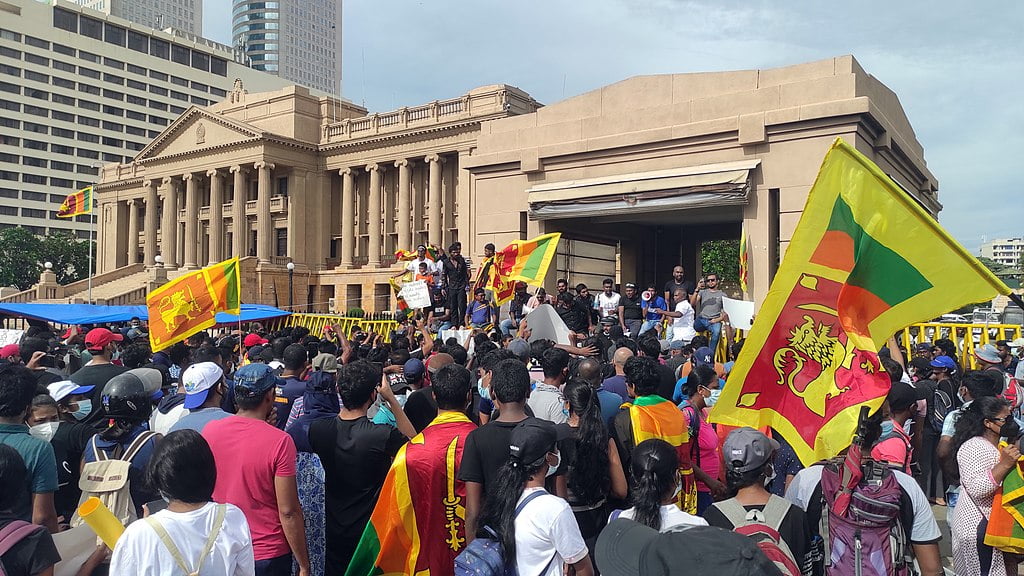
AntanO CCBY4.0
When Zhang Qian pioneered the Silk Road more than 2,000 years ago, he created something special: the first intercontinental trade network that would come to benefit the entirety of the Eurasian continent for centuries. Even today, the Silk Road is a part of Chinese history that almost every citizen is proud of. Fast forward two millennia to 2013, when China attempted to recreate the Silk Road—the reception was less positive, to say the least. The Belt and Road Initiative (BRI) is a global project with trillions of dollars in budget and narrative significance similar to that of the Silk Road. China plans to use this budget to invest in foreign countries, mainly in Southeast Asia, Africa, and some European regions. The BRI plan has already seen some projects begin, but very few have come to fruition. One of the most controversial endeavors was the Hambantota Port project in Sri Lanka, where China agreed to a 99-year lease of this strategically and economically significant trading port.1 Propelled by the media, reasonable doubts have risen in many Western countries regarding the legitimacy and the ulterior motives of the BRI. Many news sites in the U.S. claim that the BRI is harmful, and reflects ulterior motives such as “debt-trapping” countries or building military bases within BRI-aid recipients’ land after setting up deals that the host country was unable to meet.2 However, many of these claims are misleading and fail to account for the potential benefits of the BRI. Information released by the media can cause massive changes in public opinion, which puts significant pressure on governments, especially in democratic countries, to act in accordance with the desires of the people.3 Therefore, misinformation regarding the BRI could cause host countries to refuse Chinese investments due to misplaced public disapproval of Chinese influence. In addition, the bad reputation of the BRI could deter foreign investors from certain countries that are influenced by the BRI, which is counterproductive to the goals that the initiative is set to achieve.4 The comparison of Western claims with the perspective of local Sri-Lankan media and Chinese sources provides insight into which side is truly at fault for the Sri Lanka debt-trap while uncovering biases in the media’s portrayal of Chinese influence.
To explain the importance of media perception of the BRI, we must first examine its mode of operation. The success of the BRI relies on the willingness and effectiveness of the host countries to cooperate and take foreign direct investment from China. Biased media that exclusively publishes negative information will only lower the willingness of the host countries to cooperate with the BRI.5 For example, if the population of a hypothetical country saw news articles about Sri Lanka being trapped in debt due to unfair loans provided by China, then it is unlikely that they would accept loans from China since they would have reason to believe that China would do the same to them. The narratives perpetuated by media outlets could be accepted not only by average citizens but also by government officials who read foreign newspapers and even large companies,5 making cooperation difficult between China and the potential host country.
The negative media coverage of the BRI can also influence the decisions of foreign investors. By spreading negative information about the BRI to the masses, foreign media outlets popularize a negative attitude—foreign investors could buy into this attitude and reduce their involvement in BRI-influenced countries, as has happened with a number of potential investors with regard to the Sri Lankan projects.6
A number of articles have been released regarding China’s alleged weaponization of debt-trap diplomacy. These publications claim that Sri Lanka’s economy is not very powerful compared to China and, because of that weakness, China is attempting to seize control of important regions in Sri Lanka, such as the Hambantota Port, by offering them money for infrastructure and other domestic improvement projects. According to prestigious think tanks, such as Council of Foreign Relations and Chatham House, China plans to threaten to take back areas such as the Hambantota Port if Sri Lanka does not fulfill their end of the deal, which was made nearly impossible in the first place.7 Thus, China would gain guaranteed control of areas such as the Hambantota Port and, with this control, create trading hubs, military bases, or use it for other domestic interests. This perspective is incredibly prevalent among the Western media, and is seemingly well-received by Western audiences. However, Sri Lankan and Chinese news sources paint a very different picture.
Looking into local news sources, it was found that public opinion in Sri Lanka is quite positive regarding the BRI. One of the largest private news sources, The Island, stated that “China had been a friend when it counts.”8 In addition, China is cited to be actively helping with current financial growth. Sri Lankan CHEC port management estimates a growth of more than 140,000 jobs and $13 billion per annum from the Hambantota Port project.9 Some Sri Lankan locals believe that the Hambantota project is still beneficial to the Sri Lankan economy, contrasting with Western claims that Sri Lankan perception of Chinese intervention in the BRI is wholly negative.
Some Sri Lankan local critics continue to question China’s true intention, but these doubts appear to be largely due to misconceptions about such projects. Most prominently, some Sri Lankan nationals are afraid that China could be taking control of Sri Lanka economically. One such doubter claimed, “Every time I return to Colombo, the government has sold a bit more of the nation to China.”10 This is contradicted by the fact that the Hambantota Port initiative, the biggest BRI project in Sri Lanka, was proposed by Sri Lankan developmentalists, not Chinese strategists. Evidence shows that the Hambantota Port project was put in place primarily by Mahinda Rajapaksa, the Sri Lankan Prime Minister and President. Sri Lanka’s corrupt regime allowed for several of these projects that were sound on paper but proved to be costly and burdensome, especially in the context of Sri Lanka’s already failing economy.11 Plans involving leasing the port to other international entities began in 1970, long before the BRI existed or China was in any position to give aid. In addition, the argument that China is using the port to install military control of Sri Lanka and of the Indian Ocean is also untrue. Although it may seem probable that China should attempt to install forces, thinkers of Chatham House state that, as of 2020, there has been no evidence of military activity near Hambantota since the beginning of the 99-year lease.12 Thus, many of the concerns of the Western media about the debt trap of Sri Lanka as arranged by China’s BRI seem to be void; Sri Lanka did not start the project under any Chinese pressure, and China does not seem to have any military activity around the area that suggests the installment of foreign power.
Furthermore, China rebukes the allegations of debt trapping and harming Sri Lanka through the BRI since Sri Lanka slid into bankruptcy separately. Despite China being the initiator of the project—rendering Chinese articles somewhat unreliable—they should not be completely disregarded. Sri Lanka’s attempt at transitioning to a more efficient and advanced agricultural economy by banning artificial fertilizers provides a possible explanation, since this change ended up destroying much of their agriculture. Because agriculture was one of their largest and only sources of export and income, the country has been running a deficit ever since.13
Despite being just one face of the BRI, Sri Lanka and its Hambantota port project reveals the underlying tug-of-war between two world powers. On one side, critics carefully piece together a coherent narrative about the Chinese “debt-trap diplomacy,” suggesting that China seeks to abuse Sri Lanka’s economy through underhanded tactics to achieve a status of regional hegemony. However, local perspectives in Sri Lanka and China as well as foreign scholarly research suggest otherwise; Sri Lanka’s own corruption and economic failure played a far bigger role than initially suggested, and the BRI only helped to alleviate its economic stress through the creation of jobs and revenue. The Sri Lankan case serves as more than just another point of dispute in the great power struggle between the U.S. and China—it is also a stern warning in the age of mass media that only through careful analysis and a wide breadth of sources can conclusions be drawn about international relations.
Work Cited
1. Stuart Heaver, “Sri Lanka’s Chinese-Built Port City Stirs White Elephant Fears,” Al Jazeera, February 17, 2023, https://www.aljazeera.com/economy/2023/2/17/sri-lankas-chinese-built-port-city-stirs-white-elephant-fears/.
2. Wade Shepard, “How China’s Belt and Road Became a ‘Global Trail of Trouble,’” Forbes, January 29, 2020, https://www.forbes.com/sites/wadeshepard/2020/01/29/how-chinas-belt-and-road-became-a-global-trail-of-trouble/; Ishaan Tharoor, “China Has a Hand in Sri Lanka’s Economic Calamity,” Washington Post, July 20, 2022, https://www.washingtonpost.com/world/2022/07/20/sri-lanka-china-debt-trap/.
3. Erick Elejalde, Leo Ferres, and Rossano Schifanella, “Understanding News Outlets’ Audience-Targeting Patterns,” EPJ Data Science 8, no. 16 (2019), https://doi.org/10.1140/epjds/s13688-019-0194-8.
4. Hai Yang and Baldwin Van Gorp, “A Frame Analysis of Political-Media Discourse on the Belt and Road Initiative: Evidence from China, Australia, India, Japan, the United Kingdom, and the United States,” Cambridge Review of International Affairs 36, no. 5 (2023): 625–51, https://doi.org/10.1080/09557571.2021.1968794.
5. Daniel Lindley, “Assessing China’s Motives: How the Belt and Road Initiative Threatens US Interests,” Air University, August 1, 2022, https://www.airuniversity.af.edu/JIPA/Display/Article/3111114/assessing-chinas-motives-how-the-belt-and-road-initiative-threatens-us-interests/.
6. Council on Foreign Relations Independent Task Force, China’s Belt and Road: Implications for the United States, Independent Task Force Report No. 79, Jacob J. Lew and Gary Roughead, chairs; Jennifer Hillman and David Sacks, project directors (New York: Council on Foreign Relations, 2021), https://www.cfr.org/task-force-reports/chinas-belt-and-road-implications-for-the-united-states/recommendations; Tanner Greer, “One Belt, One Road, One Big Mistake,” Foreign Policy, December 6, 2018, https://foreignpolicy.com/2018/12/06/bri-china-belt-road-initiative-blunder/.
7. Chulanee Attanayake, “Sri Lanka’s Economic Crisis: Lessons for Those in China’s Debt,” Observer Research Foundation, March 2, 2023, https://www.orfonline.org/expert-speak/sri-lankas-economic-crisis/.
8. The Island, “China Has Been a Friend When It Counts,” June 3, 2023, https://island.lk/china-has-been-a-friend-when-it-counts/.
9. Stuart Heaver, “Sri Lanka’s Chinese-Built Port City Stirs White Elephant Fears,” Al Jazeera, February 17, 2023, https://www.aljazeera.com/economy/2023/2/17/sri-lankas-chinese-built-port-city-stirs-white-elephant-fears.
10. Stuart Heaver, “Sri Lanka’s Chinese-Built Port City Stirs White Elephant Fears,”
11. Lee Jones and Shahar Hameiri, Debunking the Myth of “Debt-Trap Diplomacy” (London: Chatham House, August 19, 2020), https://www.chathamhouse.org/2020/08/debunking-myth-debt-trap-diplomacy/references.
12. Ganeshan Wignaraja, Dinusha Panditaratne, Pabasara Kannangara, and Divya Hundlani, Chinese Investment and the BRI in Sri Lanka (London: Chatham House, March 2020), https://www.chathamhouse.org/sites/default/files/CHHJ8010-Sri-Lanka-RP-WEB-200324.pdf.
13. Attanayake, “Sri Lanka’s Economic Crisis: Lessons for Those in China’s Debt”
 Foreign Affairs Review