
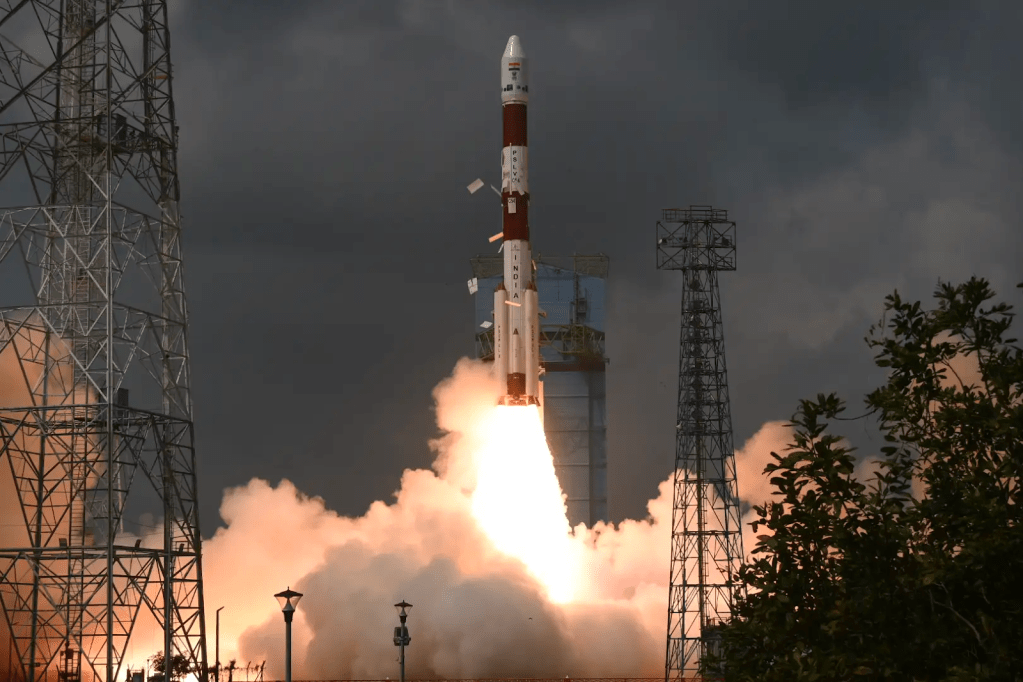
Image Credit: ISRO, PSLV-C54/EOS-06
Throughout the Cold War, the world watched as the U.S. and USSR began to play out their differences in an entirely new arena: space. The Space Race did not only represent competition in technology, but in values. Though America and Russia remain two of the world’s biggest investors in the space industry today, India is newly blasting off into the fight.
In recent years, India ranked fifth in countries’ space investments, yet it made up only 3 percent of the global space economy.1 The public Indian Space Research Organization (ISRO) has long been the near-exclusive investor in India’s space program. While some progress began in 2020, deregulation became a new imperative in 2022 after S. Somanath was appointed to succeed the outgoing K. Sivan as ISRO chairman.2 In an attempt to literally and figuratively expand the nation’s horizons, the government passed new reforms to its space industry. After three years, India officially formalized
Space Policy – 2023, which now allows non-governmental entities to “undertake end-to-end activities in space sector.”3 Not only has Somanath’s leadership and policy benefited private companies’ perceptions of India’s industry, but citizens also feel more confident in working in the ISRO.4 Without the government’s monopolistic claim to space investment, the policy heralds a transformative approach to India’s space frontier. Space Policy – 2023 establishes a playing field for private start-ups, and some have already emerged. Headquartered in India, companies such as “Skyroot” and “Pixxel” have each already received tens of millions in foreign direct investment (FDI).5 FDI refers to financing into a domestic company by an investor outside the country. If India continues to mount its private innovation, it will receive increasing investment, and it has the chance to gain up to a $100 billion share in the global space industry over the following decades.6
Beyond the initial economic boost, increasing FDI in the space sector demonstrates the government’s new willingness to welcome international companies and encourages private industries, space or otherwise, to establish their operations in India.7 While the ISRO had previously claimed dominance over India’s space industry, Space Policy – 2023 will ease business relations with private enterprises. Rebranding the ISRO certainly presents an opportunity for the country to reach broader FDI goals and attract global investment. From catalyzing jobs to stimulating diverse competition, FDI generally yields positive, long-term implications for nations’ economies.8
Critically, the benefits of India’s space policies go beyond economics; they also have important political implications. India’s new effort toward collaboration has positioned the country as an ally of the United States. Just months ago, Indian Prime Minister Narendra Modi visited the U.S. to meet with governmental leaders and NASA officials. Working with the United States helps to legitimize India’s growing space program, and multiple Indian-American partnerships were announced during Prime Minister Modi’s trip. Most notably, India became the 27th country to sign on to NASA’s “Artemis Accords.”9 The Artemis Accords are a symbolic set of international principles aimed at establishing peaceful cooperation in space. Adding India’s signature, considering the country’s prominence in space, was critical to validating the Accords. Notably, Russia has openly opposed the Artemis Accords in the past as a form of American soft power.10 Contrary to Russian interests, working with other countries increases American influence in the world. Influence in space has historically translated to power on Earth; as India unites with the U.S., it sends a clear commitment to aligning with democratic power and values.
While India increases its investment in space, Russia conveniently fades from the industry. Russia’s economy, withering under Western sanctions and the cost of fighting a prolonged war, cannot afford to maintain its previous stream of space investment.11 Many nations have also ended their collaborations with Russia over its hostile invasion of Ukraine, leaving the country isolated. Without funds or technology from former allies, Russia’s space program is hemorrhaging — a shadow of its former self. Meanwhile, India’s economy is only growing from a new frontier of FDI.12 India is mounting space missions with the United States and gaining access to American research and development through the Artemis Accords. As Vladimir Putin is entirely focused on Ukraine, he cannot afford to retaliate against India’s growth. Russia has left an opening for Indian hegemony, and Mike Gold, one of the original creators of the Accords, states clearly, “India will not only fill the void Russia is leaving, but will far exceed it.”13
Russia’s weakening space sector is part of a larger trend for the country. Indeed, none of Russia’s space exploration missions have been successful since 1991.14 Of note, Russia attempted its first lunar landing in 47 years this August, but the mission spun out of control and crashed.15 Conversely, just a week prior, India’s Chandrayaan-3 rover successfully landed on the moon’s southern pole.16 The closeness of these two space missions is symbolic: Russia was a crucial player in the original Cold War, yet its glory days seem to have ended. As India prevails to fill its vacuum, shifting space superiority could signal a new international order.
The Space Race of the 1950s and 60s saw the democratic U.S. fight for ideological dominance against the authoritarian Soviet Union. Today, democratic India could also be poised to surpass Russia. Though India is far from a global benchmark for political representation, it is the world’s largest technical democracy, making it more important than ever before that it expands its space capabilities while the authoritarian Russia is faltering.
Historically, the microcosm of space policy plays a pivotal role in the macrocosm of power politics. Indeed, India can use space as its path to global hegemony alongside the United States. Space Policy – 2023 opens the nation to private innovation, expanding its economy and access to advanced technology. India’s investment means keeping a historical enemy at bay while solidifying new alliances. Ultimately, space is a literal out-of-this-world opportunity — preponderance means spreading democratic values to new bounds.
Work Cited
1. Sheetz, Michael. “Investing in Space: India is the industry’s ‘sleeping giant, ’ according to an expert behind the international Artemis Accords. ” CNBC. June 29, 2023. https://www.cnbc.com/2023/06/29/investing-in-space-india-is-a-sleeping-giant-expert-says.html.
2. Bhattacharjee, Nivedita . “India’s ISRO changes social media and private partnership. ” Reuters. September 28, 2023. https://www.reuters.com/world/india/social-media-private-partnership-inside-changes-indias-space-agency-2023-09- 29/ .
3. “Indian Space Policy – 2023. ” https://www.isro.gov.in/media _ isro/pdf/IndianSpacePolicy2023.pdf .
4. Bhattacharjee, Nivedita .
5. Siddiqui, Huma. “India soon going to allow 100% FDI in space sector. Is this good or bad?” Financial Express. May 29, 2023. https://www.cnbc.com/2023/06/29/investing-in-space-india-is-a-sleeping-giant-expert-says.html .
6. Arakali, Harichandan. “How India’s space economy could hit $100 billion by 2040. ” Forbes India. July 26, 2023. https://www.forbesindia.com/article/news/how-indias-space-economy-could-hit-100-billion-by-2040/87001/1 .
7. Policy Circle. “India set to open space sector to global investors. ” May 29, 2023. https://www.policycircle.org/economy/fdi-in-indian-space-sector/ .
8. Padia, Sanchi. “Advantages of Foreign Direct Investment. ” Invest India. June 12, 2019. https://www.investindia.gov.in/team-india-blogs/advantages-foreign-direct-investment .
9. Sheetz, Michael.
10. Whittington, Mark R. “Will Russia rejoin the international community through space, post-Putin?” The Hill. October 16, 2022. https://thehill.com/opinion/international/3688772-will-russia-rejoin-the-international-community-through-space-post -putin/ .
11. Fernholz, Tim. “India is replacing Russia as 21st-century space power. ” Quartz. August 23, 2023. https://qz.com/india-is-replacing-russia-as-a-21st-century-space-power-1850765691 .
12. Ibid.
13. Sheetz, Michael.
14. Fernholz, Tim.
15. Westfall, Sammy. “India’s moon landing sets the tone for a new type of space race. ” Washington Post . August 31, 2023. https://www.washingtonpost.com/world/2023/08/31/india-space-moon-russia-china-nasa-chandrayaan-3/ .
16. Ibid.
 Foreign Affairs Review